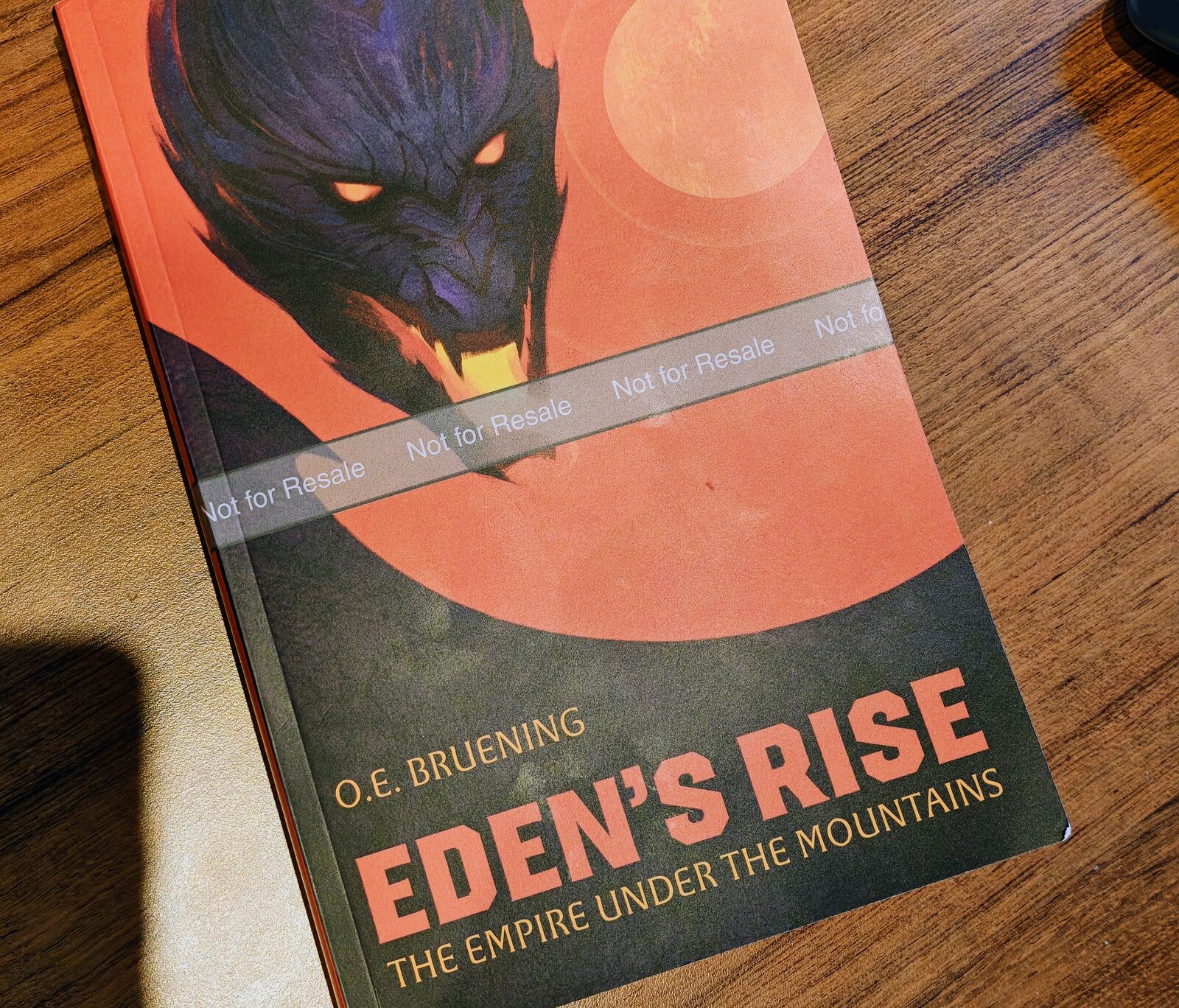
$0.12 a Book: The Unit Economics of an Indie Author
Writing · O.E. Bruening
Here is a number that'll likely surprise you: for a $17.99 paperback of Eden's Rise sold through a bookstore, I make $0.12. Not 12%. 12 cents!
Most people, including myself when I started, have no idea how the economics of the book industry work. So I figured it might be worth sharing why the same book can cost $18 when I publish it and $12 when Penguin does.
Note: this post covers printed books only. Ebooks and audiobooks run on different economics, and they'll get their own post soon.
Three Ways to Get a Printed Book Into the World
As an independent author, you have three primary options for getting a physical copy of your book in front of a reader.
- Ingram. The distributor most readers have never heard of, and the one that matters most. If a bookstore orders a book, including Barnes & Noble, it is almost certainly ordering it from Ingram.
- Amazon. Its own separate printing and distribution pipeline, run through Kindle Direct Publishing (KDP).
- Yourself. Pay to print copies up front, warehouse them, and sell them from your own website.
Most indie authors, myself included, end up using more than one of these at once.
Ingram: The One Bookstores Actually Use
Ingram is the backbone of physical book distribution. It's not a retailer readers interact with directly, it's the wholesaler that sits behind almost every bookstore. If you want your book to be orderable, you need to be on Ingram. There's no way around it.
For an indie author, that means going through IngramSpark, Ingram's print-on-demand arm. Print-on-demand (POD) is a mixed blessing. On the upside, you never pay to print a book that might not sell. A copy only gets printed once a bookstore or customer actually orders it. On the downside, it comes with real constraints: you're limited by available book sizes, a narrow choice of paper stock, and a high cost per copy. You've got to work inside a template, and the per-unit economics are worse for it.
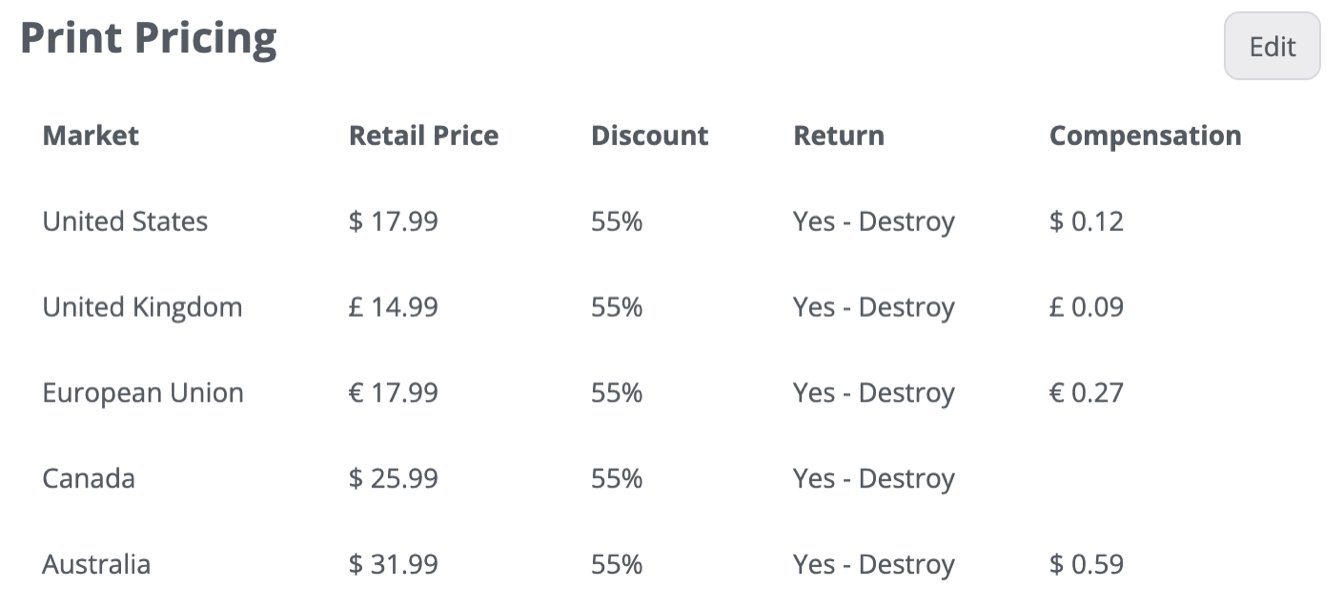
As an author, you set first the list price (e.g. $17.99 for my paperback) and then add what is called a "discount." That's typically 55%, meaning you agree to sell the book to Ingram and the bookstore for 55% less than the list price. That 55% is then split between the two of them.
| Line item | Amount |
|---|---|
| List price | $17.99 |
| Bookstore's cut (40%) | $7.19 |
| Ingram's cut (15%) | $2.70 |
| Print cost | $7.64 |
| Additional Ingram fee | $0.33 |
| Author payout | $0.12 |
The bookstore buys the book from Ingram at 60% of list price ($10.80) and sells it to the customer at full price, pocketing the 40% difference. Of the 60% paid to Ingram by the bookstore, Ingram takes its 15% cut for running the distribution infrastructure and, because this is print-on-demand, the cost of actually printing the copy ($7.64), along with another small fee. So of the $10.80 paid by the bookstore to Ingram, Ingram keeps $10.68, which leaves $0.12 for the author.
One caveat worth knowing: Ingram will also distribute third-party printed books (i.e. not POD), but only if you can show at least $50,000 in sales for each of the past two years. For an indie author starting out, that's simply not on the table.
Another caveat: when a bookstore can't sell the books, they want to have the option to return them to Ingram. When that happens, the author has to pay. Ingram does offer authors to set a "no return" policy, but it's not practical: bookstores will not order books they cannot return as they're unwilling to take the risk. Returned books are typically destroyed (and hopefully recycled).
Amazon: Hated by the Industry, Kind to the Author
Amazon is not popular in publishing circles, largely because its size allows it to cut out the middlemen, all of whom take their little percentage of the book sales.
And that's a win for the authors. KDP is easy to use and the printing turnaround is fast. When I upload a new file, I typically have a printed copy in my hands within about a week. Ingram, by comparison, usually takes more than two weeks to print, and its support can take a week or more to respond at all.
The economics are better too. Amazon takes a flat 40% and charges no additional fees. Its print costs also run a bit lower than Ingram's.
| Line item | Amount |
|---|---|
| List price | $17.99 |
| Amazon's cut (40%) | $7.20 |
| Print cost | $6.18 |
| Additional fees | $0.00 |
| Author payout | $4.61 |
Same exact book, same list price, and the author payout jumps from $0.12 to $4.61.
This is why most indie authors, myself included, will list the same title on both platforms: Ingram because it's the only way into physical bookstores, and Amazon because it's where the actual margin lives.
Printing It Yourself
The third option is to skip both distributors and print the book yourself using a third-party printer, the way I do with the Eden's Rise Author's Edition. You pay for a print run up front rather than paying per copy on demand, which usually brings the per-unit print cost way down.
But that's where the advantages stop and the operational pain begins. Because you print a big batch, you now have to store that inventory somewhere, pack and ship every order, and carry the risk of copies that don't sell. You also can't sell that book through Amazon or Ingram, so typically you'll need to sell it through your own site using something like Shopify. And that means you have to do your own marketing, get people to buy from your website instead of Amazon. Good luck with that!
I had personal reasons to go this route for the Author's Edition and am still in the middle of all the operational pieces. Once that settles, it'll likely deserve its own post, especially since there were some painful (and expensive) learnings here too.
Why My Paperback Costs $18 and Penguin's Costs $12
Publishers like Penguin print in large offset runs, tens of thousands of copies at once, rather than one at a time on demand. Because of those efficiencies, their cost per copy is a fraction of what print-on-demand costs. Big publishers also own or control their own distribution, dramatically reducing that cost. These savings allow the traditional publishers to have much more competitive pricing while retaining sufficiently meaningful margins. Although, to be fair, their margins are slim too. This is not a kind industry.
What This Actually Means
When I started off, I was, to be honest, quite naive. I thought I could print my own book (the Author's Edition) and sell it to bookstores everywhere. But that's not how the industry works, and as an unknown independent author, your only option is to play the game by the rules.
None of this is a reason not to self-publish. I still appreciate the control I have over the final books. But it was hard work tweaking and trying to get everything within the existing frameworks.
But the $0.12 stings, especially when, at $17.99, the book is already at the upper end of what a consumer is willing to pay for a paperback. And increasing the price is not really that meaningful as an option. At $18.99, I get $0.55, and at $19.99, I get $0.99. You need to sell thousands and thousands for that to add up to something remotely meaningful. Given that even at higher prices these royalties won't pay my bills (gotta keep my day job a while longer), I decided to keep the price as low as possible for the consumer.
One big learning I took from this, however, was to keep an eye on word count for my next novel. Eden's Rise clocked in at 108,000 words, which is pretty standard for fantasy. But since a lower word count means less paper (the primary driver of the printing cost), my goal for the next novel is now to be more in the 80,000 to 90,000 range. We'll see if I can get there.