800 Hours and Six Drafts — Part 1
Writing · O.E. Bruening
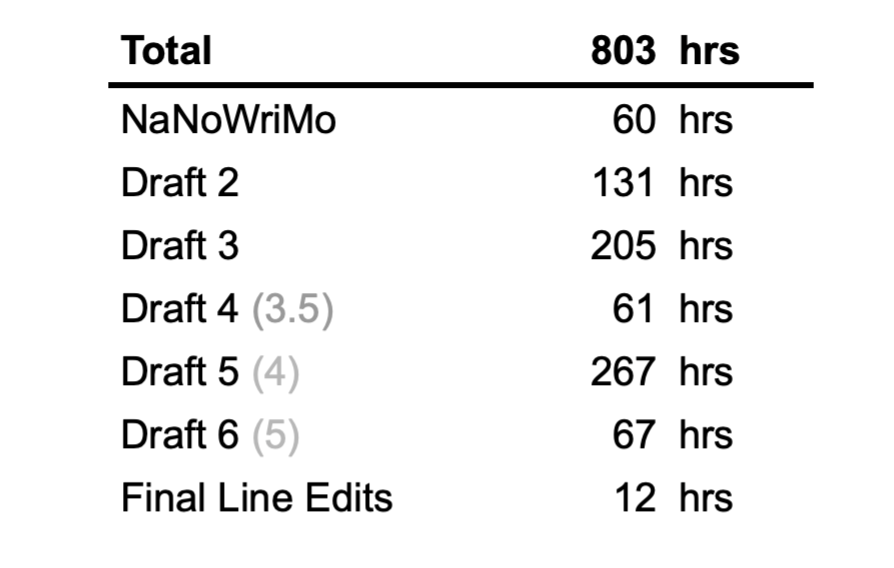
When I started writing Eden's Rise during NaNoWriMo in November 2022, I thought it would take six months. Maybe a year, if things got complicated. That first month became a mad dash creating sixty thousand words of pure momentum. But at the end, the first draft existed! And needed a ton more work.
Over the following 3 years, I learned a few things. For one, I'm a slow writer. The words don't come that easily to me. I have a sense of where the story has to go but getting it on the page takes effort. I also learned that I enjoy editing. I love it when a paragraph flows better because I cut a sentence. Finally, I'm a "pantser" (vs. "plotter"): when I feel like my characters backed themselves into a corner, I usually can't think (plot) my way out of it. But the moment I start writing, the characters start being themselves and the solution to the problem presents itself. I think of "pantsing" more as "channeling", because that's what it feels like.
Obsessed with Data
I love tracking things. And spreadsheets.
- I tracked the word count progress during NaNoWriMo (goal: at least 1,500 words per day) in a spreadsheet.
- Then I began tracking the time I spent rewriting. I set up a shortcut on my phone to switch it into a special focus mode: no calls, no notifications, nothing. Upon activation, a timestamp is written to a file. When turned off, it adds another. Occasionally, I'd load the file into a Google Sheet and run the analysis from there. This led to the 800 hours of writing and doesn't even account for research, thinking, planning, and other stuff. Just focused writing and editing.
I think there's something about the meticulous tracking that resonates with the German in me. I find it satisfying to watch the numbers tick up.
After each session I wanted to see what changes I had made and began exporting the manuscript into a text file, version controlled by GitHub, which is how I generated this video once I was done. Each box represents a paragraph. Each line is a chapter. Red means deletion, green means addition, yellow means it was changed.
What Each Draft Taught Me
Most of my writing sessions were about an hour, sometimes an hour and a half. On weekends I occasionally went longer, up to four hours, but that was the exception. The real work happened through consistency, not marathon sessions. Sitting down again and again for four to six months at a time. Then I'd take a break for a few months and review the last draft with fresh eyes. And start again.
The first draft was about getting the story out. The second was a major rewrite: cleaning up the structure, building toward a big battle at the end. I shared it with a few early readers. Their feedback helped, but it also made clear how much further the book needed to go.
The third draft was the biggest transformation. I moved the Aleena timeline to eighty years before the main story and connected it to the Battle of Dyiundur. Halin ended up in prison. Faras's arc with Sal took shape. I added new chapters giving more detail to Empire City and the resolution in the second city. The book nearly doubled in length, from 60,000 to 110,000 words. The novel began to take shape.
Draft four was careful line editing. Tightening, cutting, bringing it down to about 105,000 words. Draft five introduced new plot changes: Aleena's fate in the epilogue, a new opening scene with Yorrek, and combining two different characters into the one Richard. Draft six was smaller cleanups driven by editor feedback. Anya got more agency. Details sharpened. The final sprint was the incorporation of my editor's line edits.
With every draft, I always went through the entire novel, beginning to end. It's easy to focus on the sections you know need work, but reading the whole thing each time is how you catch the seams. It's how you notice that a change in chapter three breaks something in chapter twenty-seven. And it's how your prose quietly improves across the board, because you're not just fixing problems. You're rewriting with everything you've learned since the last pass.
The Wall After Draft Three
The hardest moment wasn't the beginning. It was after the third draft. I'd put in over a year of work at that point. The Aleena timeline was in place, the structure felt solid, and for the first time, I thought: this is actually pretty good. I took a break. I shared it with beta readers. Their feedback was generally positive, but it also made clear that there were gaps I hadn't seen.
That was the moment I had to take a deep breath to recalibrate. This wasn't going to be a quick project. It wasn't going to be "write a book, publish it, move on with life." It was going to be draft after draft after draft until the book was genuinely good. I had to accept that it might take years. Which it did.
Getting Better Every Day
One of the things I didn't expect was how much my actual writing would improve over the course of the project. Not just the story, not just the structure, but the prose itself. Sentence rhythm, word choice, flow.
Drafts five and six were where I started to feel confident. I stopped repeating words. I developed an instinct for pacing. Paragraphs began to feel right. And every sentence, every word was now on the page for a reason, had survived ruthless editing again and again.
Writing as a Passion
800 long hours. Six complete drafts. Three and a half years. And I loved it. I loved how writing took me away from everything else and engaged a part of my mind that nothing else reaches. It's something I hold dear, and it will be part of me for the rest of my life.